


Week of June 15, 2026
Published every Monday: Get a detailed snapshot of what moved the markets last week—and what to watch this week.
What is the economic impact of the World Cup?
Excitement over SpaceX’s record-breaking IPO on Friday and signs that a deal between the U.S. and Iran was imminent sent markets higher around the world last week. The Russell 2000 Index led the way, rallying almost 4 percent. Fixed income markets also moved higher on expectations of a deal.
Weekly Quick Hits
![]()
Consumer and producer inflation continued to accelerate due to higher energy prices and supply concerns.
BEYOND THE HEADLINES:
What is the economic impact of the World Cup?
Over the next five weeks, the eyes of the world will be on the U.S., Canada, and Mexico as they host the World Cup. A total of 104 games will be played at 16 host stadiums, 11 of them in U.S. cities. According to Goldman Sachs, these 11 cities account for one-third of U.S. GDP and one-fourth of U.S. employment.
Whether it’s the Olympics, the Super Bowl, or a major concert tour, large-scale events clearly have an economic impact. The Taylor Swift Eras tour in 2023, for example, is estimated to have added roughly $5 billion to the U.S. economy.
What Could the Impact Be?
The World Cup is likely to have its biggest impact on employment and retail sales. It’s important to note that some of this impact may already have shown up in May, as temporary workers were hired and consumers booked hotels and airfare in advance. We also expect the tournament to continue affecting economic activity throughout June and July. With consumers driving 70 percent of the U.S. economy, more jobs and higher spending could also affect GDP growth. The biggest economic impact will likely be felt at the local level, including a potential short-term uptick in inflationary pressures.
How Long Will the Benefits Last?
Although any positive impact on economic growth is welcome, the benefits of the World Cup will not last. Temporary employees hired to meet increased demand will come off payrolls. While headlines may show strength in several economic data points during the tournament, much of that effect will likely fade by the time the NFL season starts.
A Reminder About Diversification
Although it’s interesting to consider the impact that high-profile events can have on the economy, it’s important to remember that these effects are relatively small in the grand scheme of things. As a result, they are unlikely to influence Fed policy and should not affect portfolio decisions. With 48 teams in the World Cup, there will be a diverse range of options for fans to root for—with plenty of long shots, underdogs, and favorites. This is also a good reminder of the benefits of diversification across sectors, industries, companies, and geographies within a portfolio as investors navigate both potential upside and downside risk.
“Whether it's the Olympics, the Super Bowl, or a major concert tour, large-scale events clearly have an economic impact. The Taylor Swift Eras tour in 2023, for example is estimated to have added roughly $5 billion to the U.S. economy. ”
Report Releases: June 8–12, 2026
Consumer Price Index (CPI):
May (Wednesday)
Headline and core consumer inflation continued to rise last month, with headline inflation exceeding 4 percent on a year-over-year basis and reaching its highest level since April 2023.
- Prior monthly CPI/core CPI growth: +0.6%/+0.4%
- Expected monthly CPI/core CPI growth: +0.5%/+0.3%
- Actual monthly CPI/core CPI growth: +0.5%/+0.2%
- Prior year-over-year CPI/core CPI growth: +3.8%/+2.8%
- Expected year-over-year CPI/core CPI growth: +4.2%/+2.9%
- Actual year-over-year CPI/core CPI growth: +4.2%/+2.9%
Producer Price Index (PPI):
May (Thursday)
Producer inflation increased last month; headline price growth rose to 6.5 percent on a year-over-year basis, the fastest growth rate since November 2022.
- Prior monthly PPI/core PPI growth: +1.1%/+0.7%
- Expected monthly PPI/core PPI growth: +0.7%/+0.5%
- Actual monthly PPI/core PPI growth: +1.1%/+0.4%
- Prior year-over-year PPI/core PPI growth: +5.7%/+4.9%
- Expected year-over-year PPI/core PPI growth: +6.4%/+5.4%
- Actual year-over-year PPI/core PPI growth: +6.5%/+4.9%
Preliminary University of Michigan Consumer Sentiment Survey:
June (Friday)
After reaching historic lows last month, consumer confidence improved in June, due in part to falling inflation expectations.
- Expected/prior month sentiment: 46.0/44.8
- Actual sentiment: 48.9
The Takeaway
- Consumer and producer inflation accelerated as higher oil prices continued to affect the data.
- Consumer confidence improved in June from its historic low in May.
Financial Market Data
Equity
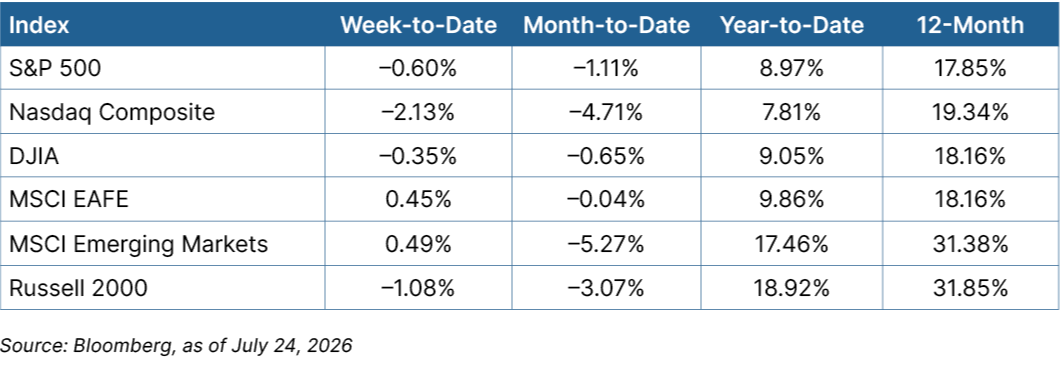
Renewed optimism about a potential settlement to the war in the Middle East and the successful SpaceX IPO buoyed investor sentiment, offsetting midweek weakness. All three major large-cap indices closed the week higher. The small-cap Russell 2000 Index rallied nearly 4 percent. Breadth was positive, with the equal-weight S&P 500 up almost 2 percent. The materials, consumer staples, and financials sectors each rose 2 percent. Communication services led decliners, falling nearly 2 percent. International markets moved higher.

Fixed Income
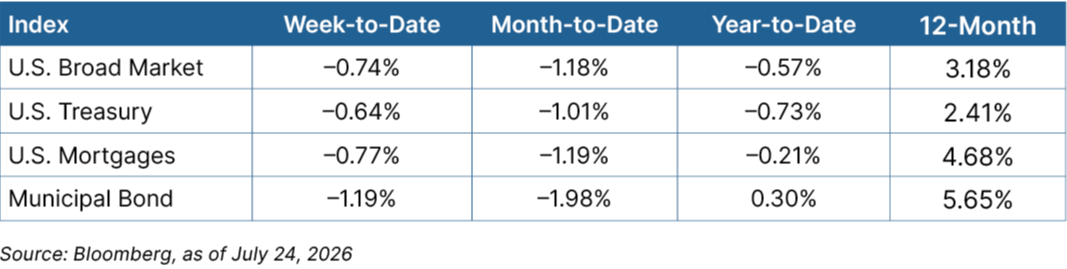
The prospect of a deal in the Middle East also supported a bond market rally, pushing intermediate-term yields lower. The 10-year Treasury yield fell 4 basis points (bps) to close at 4.49 percent. Core bonds and high-yield bonds rallied, while municipal bonds declined marginally.

The Takeaway
- A potential end to the war in the Middle East and SpaceX’s record-breaking IPO pushed all three large-cap U.S. indices slightly higher. The small-cap Russell 2000 rose almost 4 percent.
- Fixed income markets were also broadly higher, and the 10-year yield fell to 4.49 percent.
Looking Ahead
The first meeting of the Federal Open Market Committee (FOMC) under new Fed Chair Kevin Warsh will be this week’s focus for investors.
- The week kicks off on Wednesday with retail sales data for May. Consumers are expected to continue spending, and retail sales are expected to show another solid month of year-over-year gains.
- Also on Wednesday, we anticipate the release of the FOMC decision. Although economists and investors don’t expect a change in interest rates this month, they’ll be watching for any dissenting votes and listening to Warsh’s comments at his first post-meeting news conference.
Disclosure: This material is intended for informational/educational purposes only and should not be construed as investment advice, a solicitation, or a recommendation to buy or sell any security or investment product. Diversification does not assure a profit or protect against loss in declining markets, and diversification cannot guarantee that any objective or goal will be achieved. Please contact your financial professional for more information specific to your situation.
Bonds are subject to availability and market conditions; some have call features that may affect income. Bond prices and yields are inversely related: when the price goes up, the yield goes down, and vice versa. Market risk is a consideration if sold or redeemed prior to maturity.
Certain sections of this commentary contain forward-looking statements that are based on our reasonable expectations, estimates, projections, and assumptions. Forward-looking statements are not guarantees of future performance and involve certain risks and uncertainties, which are difficult to predict. All indices are unmanaged and are not available for direct investment by the public. Past performance is not indicative of future results. The S&P 500 is based on the average performance of the 500 industrial stocks monitored by Standard & Poor’s. The Nasdaq Composite Index measures the performance of all issues listed in the Nasdaq Stock Market, except for rights, warrants, units, and convertible debentures. The Dow Jones Industrial Average is computed by summing the prices of the stocks of 30 large companies and then dividing that total by an adjusted value, one which has been adjusted over the years to account for the effects of stock splits on the prices of the 30 companies. Dividends are reinvested to reflect the actual performance of the underlying securities. The MSCI EAFE Index is a float-adjusted market capitalization index designed to measure developed market equity performance, excluding the U.S. and Canada. The MSCI Emerging Markets Index is a market capitalization-weighted index composed of companies representative of the market structure of 26 emerging market countries in Europe, Latin America, and the Pacific Basin. The Russell 2000® Index measures the performance of the 2,000 smallest companies in the Russell 3000® Index. The Bloomberg US Aggregate Bond Index is an unmanaged market value-weighted performance benchmark for investment-grade fixed-rate debt issues, including government, corporate, asset-backed, and mortgage-backed securities with maturities of at least one year. The U.S. Treasury Index is based on the auctions of U.S. Treasury bills, or on the U.S. Treasury’s daily yield curve. The Bloomberg US Mortgage Backed Securities (MBS) Index is an unmanaged market value-weighted index of 15- and 30-year fixed-rate securities backed by mortgage pools of the Government National Mortgage Association (GNMA), Federal National Mortgage Association (Fannie Mae), and the Federal Home Loan Mortgage Corporation (FHLMC), and balloon mortgages with fixed-rate coupons. The Bloomberg US Municipal Index includes investment-grade, tax-exempt, and fixed-rate bonds with long-term maturities (greater than 2 years) selected from issues larger than $50 million. One basis point is equal to 1/100th of 1 percent, or 0.01 percent.
Authored by the Investment Research team at Commonwealth Financial Network®.
© 2026 Commonwealth Financial Network®
Let’s Talk About Your Financial Future
Whether you’re navigating a volatile market or preparing for the future, we’re here to help.